Wednesday, March 2, 2016

Taum Sauk Mountain State Park: Welcome to the Top of Missouri!


A little over a year ago I took on "Big Buford"... No, not the delicious arterial clogging burger they sell at Rally's/Checkers, but Buford Mountain, located just a few miles outside of Ironton, Mo. Buford Mountain is the 3rd highest point in Missouri and was a well earned victory as I took on it's 10.6 mile loop trail and enjoyed every single second of it. But I have to admit, the very second I finished the Buford Mountain trail loop and I began my ride home my mind was instantly alight with visions of taking on Taum Sauk Mountain, which is officially Missouri's highest point. I needed to make some calls, I would need oxygen, heavy parkas and perhaps a Sherpa or two... Right?

No oxygen tanks or Sherpa needed...
Taum Sauk Mountain makes up one of many mountains found in the St. Francois mountain range created by a Precambrian igneous uplift that is far, far older than the Appalachians. In fact, many geologists believe that Taum Sauk may be one of the few areas within the United States that has never been covered by ancient seas, most likely existing as islands during that time. Topping out at 1,772 feet, accomplishing Taum Sauk's summit was a bit easier than cresting Big Buford. To reach the official top of Missouri it was actually a short walk from the parking lot, only 1,000 feet down a paved trail, to a granite marker near a large boulder. I thought that may rob a bit of the "coolness" from the accomplishment, but honestly... It didn't. I was still at the top of Missouri, so a selfie was in order. But soon I thought, I really came to hike with my furry friend Hyatt, what should we do, where can we go? And it was then that I remembered, Taum Sauk Mountain State Park hosts not only the highest point in all of Missouri, but it also contains the state's highest waterfall, Mina Sauk Falls and I had heard tail that this trail was not quite as "accessible". So, after snapping a few pictures we made our way down the trail, anxious to view the falls.

Want to "earn it"? Take the Mina Sauk Falls trail...
I'll reiterate my desire to have a bit of a hike so that my hiker pride would feel as though the accomplishment of visiting Taum Sauk Mountain was not one of great ease, but earned through the sweat of my brow and the protesting of calves and quads. As I followed the trail to Mina Sauk Falls, it became apparent that this hike would be earned as the trail faded from paved trail, to rock lined trail, to gravel trail and finally to a foot worn path of Earth, leading through the forest toward our watery goal. Now, those who are "in the know" realize that Mina Sauk Falls only run in wet weather, which is one of the reasons I timed my trip here after we had received some rain during the week, so that foot worn path became very, very sloppy. In spots the trail greedily ate my entire shoe, replying only with a "splooch" as I pried my foot from its grip. My hairy buddy however, was absolutely in his element, galloping and prancing in the mud and muck as I could only think about how much fun it would be driving home with a wet and muddy pooch...


From the mud to stone...
The muddy, Oak and Hickory lined wooded trail gave way to our first glade, where a keen eyed hiker may find life better suited for a desert lying about the warm, barren rock. Lizards normally dart across this empty expanse, searching for their insect prey. But it was far too cold for our reptile friends to be emerging just yet. So we enjoyed the melodies of the feathered inhabitants, which drifted easily to our ears, serenading us as we made our way over the stony floor. As we moved forward along the trail I had to pay particular attention to my footing as the rock was very slippery in spots due to the rain water still draining from the mountain, so please, pay particular attention here for wet spots. I will readily admit, it was very hard to look down at my feet, concentrating on my footing with such a stunning view of the Arcadia Valley sweeping in a nearly full 360 panorama. I had to stop, pause and take in an eyeful, so I found myself a nice boulder to perch on and enjoyed a cool drink of water, allowing all my senses to be filled, enjoying the view as the songbirds created the score for this outstanding scene. But my hairy buddy was ready to go, so I was brought back to task by wet tongue and muddy paws upon me. Before we pressed on though I had to snap a photo... or two.

Onward to Mina Sauk Falls
The trail to the falls continued to waver from earth to rock and back again as it continued downhill, and was fairly well marked. However, at one particular point there seemed the foot worn trail led straight, and had it not been for a well placed timber, I would have missed my turn to remain on the trail, so do pay attention as the trail may fade in and out in spots. As the path began to follow the gentle curves of the mountain I could hear rushing water and my mind was awash in anticipation of what was just out of sight. As the trail led slightly back uphill and around a huge, precariously perched boulder, I caught my first sight of Mina Sauk Falls and the crystal clear waters cascading from the top of the fall, stream over a series of ledges and finally end its journey down 132 below. There is something about a waterfall that fills not only my senses, but also my soul. Honestly, I feel completely at peace and find absolute solace in listening intently to the crashing of the water while being cooled by the mist rising from the impact. After soaking in the falls, I realized that I had forgotten a few things, most notably the filter I use to create the cascading fall pictures and my tripod, however the falls washed away any concern of that and I snapped the photos I could with my camera but left with even more vivid pictures taken with my mind's eye. I followed the Ozark Trail down the mountain, being very careful to avoid loose and wet rock in order to gain different perspectives on the falls. It was at the base of those falls that I simply sat, for how long I honestly don't know, and watched the falls simply...  fall. From here I could carry on for another mile and see another great wonder of the area, the Devil's Tollgate or journey another ten miles to reach Johnson's Shut Ins, but I was running short on time, so I began my ascent back up to the top of Mina Sauk Falls to begin my uphill return hike.

A tragic legend for the beautiful falls
As I made my way back down the mile and a half trail, I thought of the legend of Mina Sauk Falls. How the chief, Sauk-Ton-Qua and the Piankashaw Indians once called this wondrous land home. In fact it was chief Sauk-Ton-Qua for which this mountain was named, who the white man called Taum Sauk, because his name was hard to pronounce. The Piankashaw lived in peace on these lands, but would fiercely repel any invasions made by other tribes, in particular the advancements of the Osage. It was said that Sauk-Ton-Qua had a beautiful daughter, Mina Sauk, who fell in love with an Osage warrior. One day Mina Sauk was caught in the young Osage warriors arms and taken prisoner. Sauk-Ton-Qua sentenced the young man to death, despite his daughter's pleas to spare his life. It is said that later that day the young man was executed on the very slopes of Taum Sauk Mountain. He was tossed from the crest of the mountain, crashing from ledge to ledge below with the spears of warriors, until finally coming to rest at the base of the mountain, battered, bleeding and dying. As Mina Sauk watched her lover she could no longer contain her grief and as her Osage suitor lie at the bottom of the mountain, breathing his last breaths, she cast herself from the summit as well, plunging over Taum Sauk's ledges to her death. It was then, that the great spirit became so moved by the lovers deaths that the very Earth trembled and shook, and Taum Sauk Mountain began to crack. Then a flood of water streamed forth, flowing over the very same stones as the lovers, washing away their blood. Such a tragic legend to explain such beauty... There are other versions of this legend, some change the name of the daughter, others create the falls with a thunderous lightning bolt, but all seem to suggest the falls were created by the great spirit's response to the treatment of the young lovers.

Pro-Tips for Taum Sauk Mountain State Park
I truly enjoyed every second I spent at Taum Sauk Mountain, from the thrill of being taller than every single Missourian for a few brief seconds to experiencing the peace that streams from Mina Sauk Falls (despite the star crossed legend) I can't recommend this park enough. I would suggest that you aim to visit the park after there has been a period of rain, especially if you want to see Mina Sauk Falls and snatch your own moment of zen from this busy, noisy world. Be sure to wear a comfortable pair of shoes that you don't mind getting absolutely covered in mud and muck. Which brings me to this... Bring a towel for your car, especially if you are bringing a four legged companion, I'm still finding bits and pieces of Taum Sauk Mountain in my truck. Also, keep an eye out for the watchtower. I didn't see it, or know it existed until I had finished my hike, returned home and began to type up this entry. I'll certainly be looking to take some shots from it on my next visit! Finally, be sure you have enough time. I didn't expect the hike to Mina Sauk to take as long as it did, and once there I didn't have enough time to press on to the Devil's Tollgate. The area is rich in wildlife, views, sights and sounds so be sure to provide yourself ample time to really take it all in.

I can't wait to go back to Taum Sauk Mountain and I will certainly make time to search for the watchtower and also make my way further down the Ozark Trail to see the Devil's Tollgate. I hope you enjoyed the write up about the area and let me know if you have any questions or suggestions down there in the comments. As always, happy trails to you!

Directions


More Information:
Local Treks on facebook 

MO State Parks: Taum Sauk Mountain Webpage
MO State Parks: Taum Sauk Mountain Hiking Trails
MO State Parks: Mina Sauk Hiking Trail Map
MO State Parks: Taum Sauk Section of the Ozark Trail Map
Missouri Department of Conservation: Taum Sauk Mountain Webpage

Friday, February 26, 2016

Shawnee National Forest Quarter Launch & Coin Exchange!

Camel Rock to be Featured on Next US Mint Commemorative Quarter
I wrote about the absolute beauty of Shawnee National Forest's Garden of the Gods back in 2014 and the images of the spectacular views there are still just as vivid today as they were then. The United States Mint must have viewed those same scenic vistas because they will soon be releasing a new quarter under the America the Beautiful Quarters Program dedicated to the Shawnee National Forest and featuring one of the Garden of the Gods most prolific sights... Camel Rock. This is quite an honor for the Shawnee National Forest System as they are one of only five national forests to be recognized by the US Mint's program. The image of Camel Rock was designed by Justin Kunz and sculpted by Jim Licaretz and features a fantastic view of Camel Rock with a red tailed hawk gliding the silver sky above.

Quarter Launch and Coin Exchange
In recognition of this honor, the United States Mint invites you to the Shawnee Forest Quarter Launch and Coin Exchange to commemorate the release of the new quarter at 10 a.m. on February 4th, 2016 at Southeastern Illinois College's Deaton Gymnasium in Harrisburg, Illinois. At the Quarter Launch and Coin Exchange you will be able to purchase rolls of the new commemorative quarters, $10 for a single roll to $100 for 10 rolls, which will be the maximum allowed for exchange. They will also be hosting a Coin Forum the evening before the event, February 3rd, at Shawnee National Forest Headquarters in Harrisburg, Illinois from 5-6 p.m.

Now you can carry a piece of the Shawnee National Forest in your pocket and it will only set you back a quarter!

More Information
Shawnee National Forest Quarter Launch & Coin Exchange Info Sheet

Directions

Wednesday, February 24, 2016

Elephant Rocks State Park: Home to Views, Trails, and... Elephants?

 I remember coming to Elephant Rocks State Park back when I was twelve years old with my parents, back in the *cough, cough* 80's... Marveling at the mammoth... er... Elephant sized pink granite boulders. Trying my hand at scaling those circus sized freaks, tracing carvings etched over 100 years ago by master masons with my fingers, gazing over the long abandoned quarry now filled with nearly a century's worth of rain, and exploring so much more. So returning as an adult was almost a homecoming, with the Elephants patiently waiting atop their weathered perch, welcoming me back to the park with a single question, "Are you ready to act like you're 12 again?" To their query, I answered quickly, "Yes", despite me putting on a couple of decades between visits.

Hike and climb among circus sized granite giants
Elephant Rocks State Park draws its name from the colossal pink granite boulders, the largest of which has been named Dumbo and is estimated to tip the scales at 680 tons! You will find an area where these boulders seem to march like a line of elephants upon a barren granite hill which graces the center of the park. If you'd like to get really technical here these pink colossi are perched on a tor, which is Gaelic for rocky hilltop, so if that comes up in a final Jeopardy! round remember who to share your winnings with. On top of the tor, shown in the picture to the left, you may find interesting pools of water, seemingly carved directly out of the granite. These pools are actually referred to as tinajitas and are caused by physical and chemical weathering of the stone, sometimes these tinajitas may be several feet in diameter and provide a home to tadpoles or the hiker's arch-nemesis, mosquito larvae. I have seen some truly beautiful pictures of these circular depressions, filled with water and reflecting their surroundings, but alas... When we visited the park each of the tinajitas we visited were as dry as a bone.

You may also notice many carvings upon the central tor and even on a few of the granite elephants that reside there. Many of the quarry workers would carve their names and date into the granite here when they received the rank of Master Stone Cutter and you will find many dates from the late 19th century, standing as silent testament to the achievements of the men who cut into their igneous bodies. You may also notice growths on some of the stone here as well, called lichens and mosses, generally you will find both of these in sunnier areas. The lichens and mosses found growing here are another piece of the puzzle that develops the unique pattern of weathering demonstrated upon the elephant rocks within the park.

Let your feet and fingers do the walking on the Braille Trail
It is around those stone circus attractions that you will find the first trail ever designed for outdoor lovers with visual or physical disabilities in Missouri, which is fondly referred to as the Braille Trail. The one mile long Braille Trail consists of a fully paved trail featuring signs with braille and regular text, you may even download a MP3 file from the Missouri Department of Conservation that provides audio for each of the interpretive signs along the trail. The Braille Trail loop (circular trail) is a fantastic way to explore the park and as you make your way along you will find spurs (offshoot trails) that lead to additional areas that you may explore, some of these spurs are handicapped accessible, but not all.

Explore the ruins and history of the old quarry
One such spur is the Engine House Ruins Trail, which is less than a half of a mile long and connects to the Braille Trail in two spots, so if you miss the first offshoot, you can catch the other.  Along this trail you will find the remains of the old Engine House, which was constructed here to repair and maintain the quarry's railroad engines. Here you can still find the old rails, now overgrown and sunken into the earth, that would have carried loads of granite from many of the local quarries to the larger railroads, such as the St. Louis, Iron Mountain and Southern Railroad, which were located some miles to the east. The building itself is eerily beautiful with the seemingly random pattern of mortared junctions really showcasing the individual stones fashioned to create it. It feels like you could almost hear the hissing of the old steam engines that would visit here if you listened closely enough...

"Missouri Red" quarried here is still found in Missouri & beyond
As you continue through the park you'll also find a spectacular overlook that provides a beautiful vantage of the old quarry that existed within the park. It has filled with decades of rain water and its steep sides clearly show the scars of the industry that shaped the entire area around the park, even factoring into the name of the nearby city of Graniteville, where you can find quarries that are still running today. It is in areas like this that a man could find himself taking home nearly $5.00 a day by cutting seventy blocks a day in the 1890's. The "Missouri Red", the trade name given to the granite products quarried from this area, can be found right here in Missouri, within the paving stones of some old St. Louis streets, the piers of the Eads Bridge and in the columns of the Missouri Governor's mansion, the granite was also shipped throughout the United States. As you soak in the eagle eye view available here take notice of the beautiful black oak and shag bark hickory trees that grow in the granitic soil here at Elephant Rock State Park.

Look for old "Plug and Feather" tools
Traveling the Braille Trail around the over 131 acre state park, you'll notice large piles of granite scattered here and there. You will undoubtedly notice that many of these granite stones bear marks of an ancient technique for splitting the dense and tough stone called "plug and feather". The plug and feather technique has been used since the pyramid builders of ancient Egypt (and maybe even earlier). It is a brilliantly simple concept and requires only a few tools to pull off, a metal wedge (called a plug) and two metal shims (referred to as the feathers). A hole is drilled into the stone along a drawn line, which is where the stone cutter wishes the large block to split, then the feathers are inserted and the plug is then placed between the two feathers. Generally there will be multiple holes drilled and multiple pairings of feathers and plugs along the intended split line. At this point the stone mason will begin to strike each plug in succession moving down the intended split line, which causes the feathers to move outward from the center as the plug is driven, continuing to strike until the stone relents and fractures along the line. If you are careful and very observant you may even find some of the old feather and plugs that the quarry workers left behind in some of the holes! The picture to the right shows the fracture of the stone and unused holes as well where the masons looked to split the slab further. However, not all of the holes you find in these rock where placed there to split the stone, some are the results of core samples, taken to determine the quality of the granite.

Don't get lost in "The Maze"
One of the last spurs that you will find off of the Braille Trail is an area nicknamed "The Maze" where you can wander and explore a section of the trail that features scattered boulders that would beckon "Climb me..." if they could speak. I spent a good amount of time here, bouldering, leaping, wedging myself into crags and cracks and generally acting like my old twelve-year-old self, however my now older body would have a serious discussion with me the following morning, just to remind me of how old I truly am. You could easily spend the bulk of your hike here trying to summit each of the boulders, each of which seems to present you with a different brain teaser of what method to use to climb them. Also keep in mind, it can be dangerous climbing on rocks and leaping from place to place. Any water on the surface of these stones can easily cause you to loose footing and slip as well, that beautiful pink granite makes a pretty slick wet surface, so be careful!

Pay homage to those who served in WWI
As you begin or end your journey on the Braille Trail you may notice a poem carved into a large granite rock face. The carving is weathered and somewhat hard to read, but if you concentrate and focus you will find that these poetic words were carved to pay respect to those who did not come home from World War I in 1918, "In honor of our nation's brave that sleeps over the wave, they died that we be free no more war to be 1918."

Pro-Tips for Elephant Rocks State Park
Elephant Rocks State Park is an extremely unique and beautiful park, so don't be surprised to find other outdoor enthusiasts filling the park on the same day you arrive. The entire area is particularly beautiful in the fall as the leaves begin to change, the black oak and shag bark hickory put on quite a display of oranges, reds, and every shade between. Be sure to bring a camera, you'll certainly want to take some pictures with these behemoths and maybe even shoot a quick selfie on some of the scenic overlooks from the tor (remember what a tor is... and remember to cut me in on that final Jeopardy! question...). Let the kids (and the kids at heart) play, explore and just generally have fun... But be careful, the beautiful pink granite here becomes slick as snot with a bit of water and remember falls onto solid rock hurt and can easily break bones. Finally, bring a picnic lunch. There are a great deal of picnic areas at Elephant Rocks, be sure to take some time out to reconnect with your loved ones and just sit back, eat and talk about just how awesome Elephant Rocks State Park is. Happy trails and thank you for reading!


Directions


More Information:
Local Treks on facebook 
Missouri Department of Conservation: Elephant Rocks Webpage
MO State Parks: Elephant Rocks Webpage
MO State Parks: Teacher's Guide to Elephant Rocks
MO State Parks: Elephant Rocks State Park Trails
MO State Parks: General Information
  - Braille Trail Map (1 mile)
  - Engine House Ruin Map (0.40 mile)
Missouri State Parks.net: Elephant Rocks
Wikipedia: Plug and Feather

Wednesday, September 2, 2015

Cache River State Natural Area: Much More Than "Mud & Muck"


When you think of a wetlands area, there is no doubt that you may quickly conjure up an image of Swamp Thing's eerie home immediately. Or, perhaps you envision a marshy bog filled with savage spiders, slippery snakes and man-sized mosquitoes, each lying in wait under an ever present layer of fog, lurking within their secret hiding places until deciding to lurch forth for you, their unsuspecting victim. But in reality, wetlands are beautiful areas that also provide a home to more than a third of the species on the U.S. Endangered Species List and serve a variety of services to us as well; such as recharging our ground water supplies, providing a filter which removes pollution, and trapping flood waters. But beyond those important ecological benefits, you will find that wetlands may provide another intangible benefit to you. You may find your own soul reinvigorated, if just given a chance to step beyond the "mud and muck" of Cache River State Natural Area...

Cache River State Natural Area

This Cherrybark Oak
Champion may be found
on the Todd Fink
Heron Pond Trail
The Cache River State Natural Area is an absolutely stunning example of a well restored wetlands area. You will find this gem nestled within a floodplain, which was sculpted by the mighty flood waters of the Ohio River ages ago. The Cache River Wetlands is now fed by the Cache River and it's many tributaries and stretches over 14,960 acres in Johnson, Massac, and Pulaski counties in Southern Illinois. This scenic area also plays as a featured stop to many migratory bird species, including bald eagles, great blue herons and (a personal favorite) snowy egrets. In addition to the myriad of migratory birds you will undoubtedly catch an earful of the areas most vocal inhabitants as choirs of spring peepers, bullfrogs, bird-voiced tree frogs, American toads and more amphibians all sing together from the bogs to the boughs and everywhere in between. As you hike on the trails and boardwalks below you may also want to keep a keen eye trained for some of the larger warm blooded residents as many white tailed deer, squirrels, raccoon, beavers, foxes and mink call the area home as well.

On our visit we were lucky enough to hike three areas within the Cache River State Natural Area (click to visit individual pages or read more below): Big Cypress Tree Trail (250 feet), the Section 8 Wood Nature Preserve Boardwalk (475 feet) and the Todd Fink-Heron Pond Trail (1.5 miles). Each of these short hikes were absolutely stunning and completely unique in their own way. These short journeys also seriously whet my appetite for a return to visit areas such as the Marshall Ridge Trail (2.8 miles), Lookout Point Trail (1 mile), and the Lower Cache River Swamp Trail (2.5 miles), but that will have to be another post at another time I suppose.

Big Cypress Tree Trail

Although missing some of its mighty boughs,
the state champion is still an impressive sight!
Beyond the wildlife that inhabits these wetlands, the area also boasts some truly spectacular plant life. Throughout the Cache Area Wetlands you will discover ancient cypress trees with their flared bases and many "knees", which were mere saplings over 1,000 years ago, now standing sentinel over the rich, black-water swamps that still nourish them. On the short, 250 foot Big Cypress Tree Trail you will find one very special bald cypress. This particular cypress tree has been so nourished by the rich waters that it has developed a remarkable base (also referred to as a buttress) of over 40 feet in circumference, which has earned it recognition as a state champion. As you make your way to the enormous namesake of this trail be sure to take note of the other plants such as majestic tupelo trees and low lying thickets of button-bush that share the landscape with the silent cypress colossus.

Section 8 Wood Nature Preserve Boardwalk

The murky waters of Section 8 are haunting.
There is something nearly hypnotic about the chorus song of nature, in particular the melodies of the amphibious inhabitants of the wetlands. The soprano trills of the tree frogs blend with the rich baritones of the southern leopard frogs, while the deep bass of the bullfrogs seem to keep the beat and complete the scale, providing the perfect background accompaniment as you stroll the wooden Section 8 Boardwalk (click here for more "Swamp Music":). As you make your way over the 475 foot long boardwalk you will be enveloped by the cypress, tupelo and other varieties of marsh loving trees, many of which you will be able to identify thanks to the wonderful interpretive panels that are available along the path. Then, as you look out upon the muddy and murky waters, perhaps wondering exactly what may lie beneath its calm surface, you may also catch sight of another state champion, this time a tremendous water tupelo, which can be found at the very end of the boardwalk. Unfortunately I just could not snap a good picture of it, or I would have provided one here for you... Now I guess you'll just have to take this serenaded trip as well. :)

Todd Fink-Heron Pond Trail

See that cool "Zipper" effect?
This short, 1.5 mile, trail begins simply enough. You'll find yourself descending into a mix of hardwood forest comprised of a mix of oak, hickory and sweet gum. As you reach the bottom of your descent you will come to a small truss bridge over which you will make your way over a convergence of Dutchman's Creek and the Cache River. If you find yourself crossing this bridge without setting an eye just upstream, toward the actual meeting of these two streams of water, you are missing a truly magnificent sight. For it is here, just upstream, where the relatively clear waters of Dutchman's Creek and the rich muddy flow of the Cache River slowly merge, becoming one, but not before the waters dance together, swirling and circling, ebbing and flowing, creating an absolutely hypnotic effect. The trail continues on just the other side of the bridge, and closely follows the snaking trail of the Cache River. As you continue your hike you will find a fork in the trail, it is here that you will want to journey to the left and in just a few short yards you will find the Heron Pond boardwalk.

The Heron Pond boardwalk winds its way out and into the very heart of its namesake pond. The waters here were more clear than we found at the Section 8 boardwalk, which allowed us glimpses of turtles, fish, insects, frogs and more as they swam among the giant tupelo trees and "knees" of the cypress here. In areas we found duckweed would obscure our little windows into the private underwater world of the swamps residents, occasionally these serene green mats of aquatic carpet would erupt with a violent "POP" as an underwater assassin would hungrily burst through the thin layer of duckweed in pursuit of an insect.

Now, after you've taken the journey on the Heron Pond boardwalk you may think that's it... But you'd be wrong. Remember that fork, where we turned left? You may be wondering what exactly would have happened had we turned right instead. Well let not your heart be troubled, because had you turned right at that fork you would have taken a trail that would have led you directly to yet another state champion tree! This time you would have discovered the state champion cherrybark oak tree that has grown to a circumference of over 22 feet and 100 feet high! You may never have quite so much fun feeling so very, very small and believe me, it's worth a quick visit to set your eyes upon this towering titan, plus it is only a few yards up that right path...

Cache River Wetlands Center 

You may want to begin your entire adventure to the Cache River Wetlands Area at the Barkhausen-Cache River Wetlands Center. Unfortunately the visitor center was closed when we visited the park on a Monday, but it certainly seems to have many offerings for you to peruse. It is located at 8885 State Route 37, Cypress, IL, 62923 and is now open to the public five days a week, Wednesday through Sunday from 9:00 a.m. to 4:00 p.m.


Directions


More Information:


Local Treks on facebook 
Cache River State Natural Area: Big Cypress Tree Trail - Looking for the state champion bald cypress? Take this trail!
Cache River State Natural Area: Section 8 Nature Preserve Boardwalk - Take a stroll directly through a swamp without even getting your feet wet!
Cache River State Natural Area: Todd Fink-Heron Pond Trail - Another state champion tree and awesome boardwalk trail!
Cache River State Natural Area homepage 
Hiking Maps of the Area
Barkhausen-Cache River Wetlands Center
Barkhausen-Cache River Wetlands Center flyer - This little beauty has many of the cool features of the center listed. 
Cache River State Natural Area Map
Color Brochure of the Area

Cache River State Natural Area: Section 8 Nature Preserve Boardwalk

Taking A Musical Stroll


The murky waters of Section 8 are haunting.
There is something nearly hypnotic about the chorus song of nature, in particular the melodies of the amphibious inhabitants of the wetlands. The soprano trills of the tree frogs blend with the rich baritones of the southern leopard frogs, while the deep bass of the bullfrogs seem to keep the beat and complete the scale, providing the perfect background accompaniment as you stroll the wooden Section 8 Boardwalk (click here for more "Swamp Music":).

As you make your way over the 475 foot long boardwalk you will be enveloped by the cypress, tupelo and other varieties of marsh loving trees, many of which you will be able to identify thanks to the wonderful interpretive panels that are available along the path. Then, as you look out upon the muddy and murky waters, perhaps wondering exactly what may lie beneath its calm surface, you may also catch sight of another state champion, this time a tremendous water tupelo, which can be found at the very end of the boardwalk. Unfortunately I just could not snap a good picture of it, or I would have provided one here for you... Now I guess you'll just have to take this serenaded trip as well. :)

Directions


More Information:


Local Treks on facebook 
Cache River State Natural Area: Much More Than Mud & Muck - An overall view of Cache River State Natural Area
Cache River State Natural Area: Big Cypress Tree Trail - Looking for the state champion bald cypress? Take this trail!
Cache River State Natural Area: Todd Fink-Heron Pond Trail - Another state champion tree and awesome boardwalk trail!
Cache River State Natural Area homepage 
Hiking Maps of the Area
Barkhausen-Cache River Wetlands Center
Cache River State Natural Area Map
Color Brochure of the Area

Cache River State Natural Area: Todd Fink-Heron Pond


A Zipper Convergence

See that cool "Zipper" effect?
This short, 1.5 mile, trail begins simply enough. You'll find yourself descending into a mix of hardwood forest comprised of a mix of oak, hickory and sweet gum. As you reach the bottom of your descent you will come to a small truss bridge over which you will make your way over a convergence of Dutchman's Creek and the Cache River. If you find yourself crossing this bridge without setting an eye just upstream, toward the actual meeting of these two streams of water, you are missing a truly magnificent sight. For it is here, just upstream, where the relatively clear waters of Dutchman's Creek and the rich muddy flow of the Cache River slowly merge, becoming one, but not before the waters dance together, swirling and circling, ebbing and flowing, creating an absolutely hypnotic effect. The trail continues on just the other side of the bridge, and closely follows the snaking trail of the Cache River. As you continue your hike you will find a fork in the trail, it is here that you will want to journey to the left and in just a few short yards you will find the Heron Pond boardwalk.

Down On The Boardwalk

The Heron Pond boardwalk winds its way out and into the very heart of its namesake pond. The waters here were more clear than we found at the Section 8 boardwalk, which allowed us glimpses of turtles, fish, insects, frogs and more as they swam among the giant tupelo trees and "knees" of the cypress here. In areas we found duckweed would obscure our little windows into the private underwater world of the swamps residents, occasionally these serene green mats of aquatic carpet would erupt with a violent "POP" as an underwater assassin would hungrily burst through the thin layer of duckweed in pursuit of an insect.

But Wait! There's More!

Now, after you've taken the journey on the Heron Pond boardwalk you may think that's it... But you'd be wrong. Remember that fork, where we turned left? You may be wondering what exactly would have happened had we turned right instead. Well let not your heart be troubled, because had you turned right at that fork you would have taken a trail that would have led you directly to yet another state champion tree! This time you would have discovered the state champion cherrybark oak tree that has grown to a circumference of over 22 feet and 100 feet high! You may never have quite so much fun feeling so very, very small and believe me, it's worth a quick visit to set your eyes upon this towering titan, plus it is only a few yards up that right path...

Directions


More Information:


Local Treks on facebook 
Cache River State Natural Area: Much More Than Mud & Muck - An overall view of Cache River State Natural Area
Cache River State Natural Area: Big Cypress Tree Trail - Looking for the state champion bald cypress? Take this trail!
Cache River State Natural Area: Section 8 Nature Preserve Boardwalk - Take a stroll directly through a swamp without even getting your feet wet!
Cache River State Natural Area homepage 
Hiking Maps of the Area
Barkhausen-Cache River Wetlands Center
Cache River State Natural Area Map
Color Brochure of the Area

Cache River State Natural Area: Big Cypress Tree Trail

What Is the Cache River State Natural Area?

The Cache River State Natural Area is an absolutely stunning example of a well restored wetlands area. You will find this gem nestled within a floodplain, which was sculpted by the mighty flood waters of the Ohio River ages ago. The Cache River Wetlands is now fed by the Cache River and it's many tributaries and stretches over 14,960 acres in Johnson, Massac, and Pulaski counties in Southern Illinois. This scenic area also plays as a featured stop to many migratory bird species, including bald eagles, great blue herons and (a personal favorite) snowy egrets. In addition to the myriad of migratory birds you will undoubtedly catch an earful of the areas most vocal inhabitants as choirs of spring peepers, bullfrogs, bird-voiced tree frogs, American toads and more amphibians all sing together from the bogs to the boughs and everywhere in between. As you hike on the trails and boardwalks below you may also want to keep a keen eye trained for some of the larger warm blooded residents as many white tailed deer, squirrels, raccoon, beavers, foxes and mink call the area home as well.

A Short Trail, Big On Visuals!

Beyond the wildlife that inhabits the Cache River State Natural Area, the area also boasts some truly spectacular plant life. Throughout the area you will discover ancient cypress trees with their flared bases and many "knees", which were mere saplings over 1,000 years ago, now standing sentinel over the rich, black-water swamps that still nourish them. On the short, 250 foot Big Cypress Tree Trail you will find one very special bald cypress. This particular cypress tree has been so nourished by the rich waters that it has developed a remarkable base (also referred to as a buttress) of over 40 feet in circumference and towers over 73 feet tall, which has earned it recognition as a state champion. As you make your way to the enormous namesake of this trail over the pavement, be sure to take note of the other plants such as majestic tupelo trees and low lying thickets of button-bush that share the landscape with the silent cypress colossus.

You may even catch sight of some fellow nature lovers out paddling among the giant trees. Many come to the area and take paddling tours, which offer additional advantages here in the wetlands. There are local businesses that can even take you on a guided tour of these impressive swamps!

Directions


More Information:

Local Treks on facebook 
Cache River State Natural Area: Much More Than Mud & Muck - An overall view of Cache River State Natural Area
Cache River State Natural Area: Section 8 Nature Preserve Boardwalk - Take a stroll directly through a swamp without even getting your feet wet!
Cache River State Natural Area: Todd Fink-Heron Pond Trail - Another state champion tree and awesome boardwalk trail!
Cache River State Natural Area homepage 
Hiking Maps of the Area
Barkhausen-Cache River Wetlands Center
Cache River State Natural Area Map
Color Brochure of the Area

Giant City State Park: Devil's Standtable Nature Trail


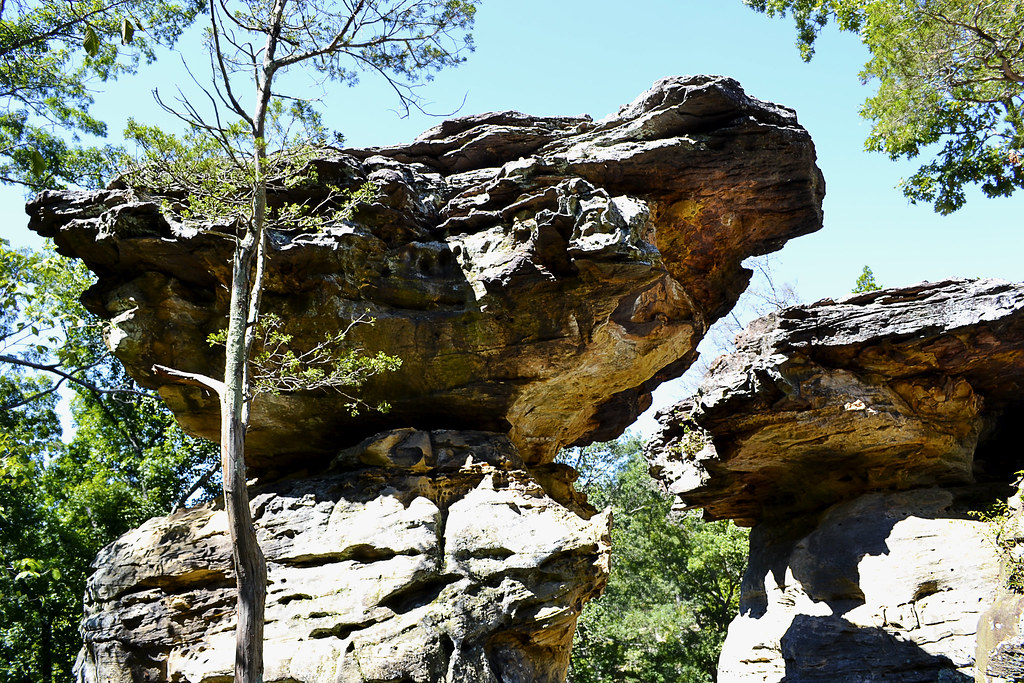
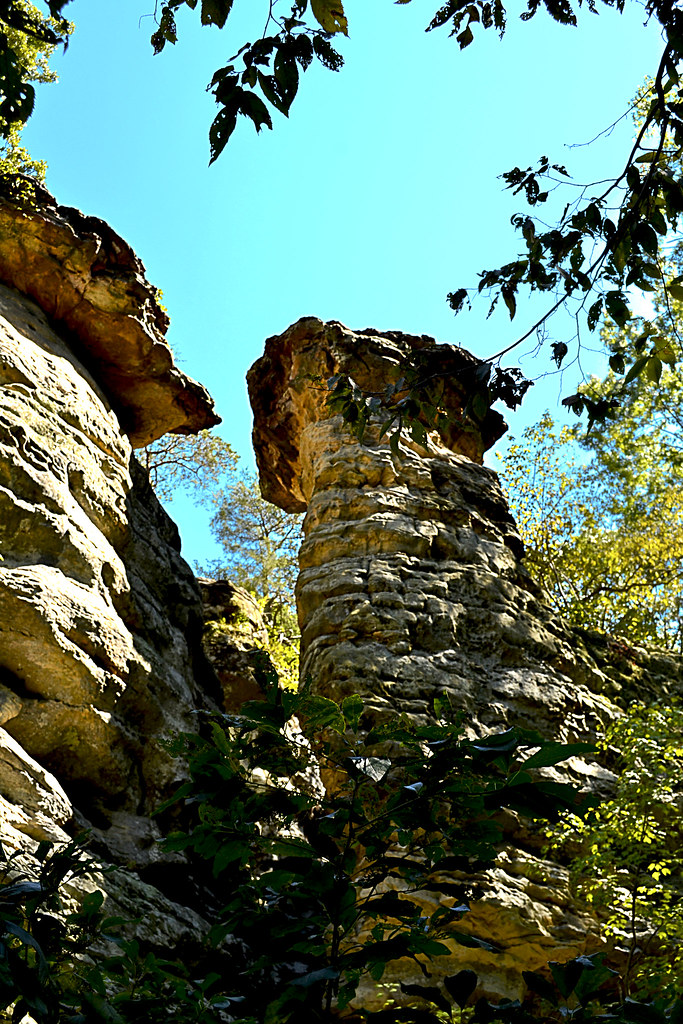
After taking in the history and spectacular view from the Stonefort Nature Trail we piled back in the old family truckster and set our sights on the Devil's Standtable Nature Trail, which was to provide a bit more of a strenuous hike and a fantastic opportunity to get in a bit of boulder hopping and rock climbing fun for me. This was another short trail, winding another one-third of a mile into the beautiful forest, and the cherry on top, the Devil's Standtable itself, was well worth the short trek. However, if you find yourself wanting to take a seat at this table you may want to bring along a mighty large chair

The Trail!

The trail begins as gravel filled forms, which create a bit of a stair case, and quickly makes its way to a dirt surfaced trail that follows the bottom of its magnificent sandstone bluff borders. As you make your way along this trail you will find numerous spots that sections of the beautiful bluffs have shaken loose from their native homes, tumbling to the forest floor and as you near the Devil's Standtable itself, you will come across a large, partially collapsed sandstone shelter which is a stone hopper's paradise! I enjoyed leaping from boulder to boulder and even doing my best "Cliffhanger" impersonation from a few of them. When I wasn't hopping from place to place, I noticed that some of these boulders had names and dates carved upon their surface, unknown to me, this was to be a bit of a foreshadowing of our next hike through the Giant City Streets.

Please, Exercise Caution

The official trail ended at a wonderful spot from which to gather a ground level view of the Devil's Standtable, but I wanted to get just a bit closer to this magnificent natural monument. Upon a bit of inspection I found a less worn trail that led to the sandstone base and quickly scrambled up the stoney incline. Let me tell you, at eye-level with the Devil's Standtable you'll surely be impressed with just how delicate the balancing of this formation is and just how fragile the difference between the Standtable staying perched upon its column or its possible plummeting from its lengthy perch! As always, I'll give warning here... Rock may become quite slippery when wet and there is always a possibility of slipping and falling while leaping, bounding, jumping, cartwheeling, flipping, climbing, sliding, handstanding or having any other type of fun on rocks. Children may also be able to get up into an area then be unable to come back down, so please always err on the side of safety.

Directions (click the Google Map below to enter in your address)


Giant City State Park
235 Giant City Road
Makanda, IL 62958
(618) 457-4836

More Information: 

Local Treks on facebook 
Giant City State Park Stonefort Nature Trail - Be sure to hit this trail too!
Giant City State Park Devil's Giant City Nature Trail - THE "go to" trail in Giant City

Giant City State Park - Official IDNR Homepage
Giant City Trails -  A list of all eight established trails
Giant City Visitor Maps - Maps provided by the IDNR of the entire park
More Photos From Giant City State Park - My Flickr Album for Giant City State Park

Monday, February 9, 2015

Using A Compass: You Can Go Your Own Way


Fleetwood Mac had it right, "You Can Go Your Own Way" anytime you like when you're out hiking and you don't need to be a Meriwether Lewis or William Clark either. All you need is a compass, a map and the knowledge of how to use it. Here's a how to on what a compass is, what parts make up the compass and how to put it all together with a map in order to find your way. Fist pumping is advised...

What's this "Twisty Thing"? - The Parts

Let's start of with some compass basics. How about we learn what the different parts of the standard compass are? Here's a quick list of what you'll find on your standard compass.


  • Baseplate: The baseplate of the compass is the clear, rectangular plate that the compass housing is attached to. It may have a ruler on one or both edges and many items printed on it. Such as the orienting arrow and orienting lines.
  • Direction of Travel Arrow: The direction of travel arrow is usually an arrow which is printed on the baseplate. It will point AWAY from the compass housing and magnetic needle.
  • Compass Housing: The compass housing is the plastic circle that contains the magnetized compass needle and some type of "mystery" fluid (I don't recommend cracking it open to take a swig of it).
  • Degree Dial: The degree dial is a numbered dial that surrounds the compass housing. You can twist this dial 360° around the compass housing. This is also the answer to the question in the heading up there...
  • Magnetic Needle: Channel your inner child and spin while holding the compass close to your body and look at it. See that two colored needle that turns as you do? That's the magnetic needle, it will always point to Magnetic North.
  • Orienting Arrow: The orienting arrow is the non-magnetic, non-spinning, arrow that lies below the magnetic needle, it is usually printed on the plastic.
  • Orienting Lines: Orienting lines are lines which are printed inside of the compass housing and run parallel to the orienting arrow.

How Do I Hold This Thing?

Now that you've familiarized yourself with the parts of the compass, let's talk about how to hold it. Oh, and if you're still spinning in a circle from the magnetic needle definition you can stop, unless your inner child is just having too much fun. Now place your hand, palm up and level, in front of your chest. Next, take the compass and place it in your upturned hand. Boom! That's how you hold it, be sure to keep the compass as level as possible in your hand. If you would like to celebrate with a fist pump, be sure to pump only the compass-less hand.

What's that? You don't want to just hold it in your hand or you want to consult a map? Well, fine then. Take your map and compass, find a nice flat and level location, then lay your map down with your compass on top of it. Once you have it all down you may now fist pump either of your paws in victory.

Now Let's Figure Out Which Direction You're Facing

Look at you, all fist pumping and knowledgeable now! Let's add to your newly found orienteering skills by figuring out which direction you are currently facing.
  1. Hold the compass flat in your hand and look down on the top of the compass housing. The magnetic needle should swing off one way or another, unless you are facing to the north. 
  2. Now, grab the degree dial (you know, the twisty thing...) and turn the dial until the orienting arrow lines up with the magnetic arrow, it should outline it to be a bit more precise. 
    • Nearly all magnetic arrows are two toned, red and white, line up the red side of the magnetic arrow with the orienting arrow. In fact, if your compass doesn't have a two toned, red and white magnetic arrow, buy one that does. Be sure to check your instructions that come with your compass though, just to be sure.
  3. Finally, spot your direction of travel arrow, remember it is most likely printed on the baseplate. Follow the line from the backside of the arrow, through the compass housing and take note of where the line intersects the markings on the compass housing. In my photo above the arrow is between the N (North) and W (West), so I am facing Northwest.
  4. What's that? You want to get a bit more specific? Well, look more closely at your compass housing and see what degree the direction of travel arrow intersects with.

Did You Know There Are Two Types Of North?

Well, there are, at least when it comes to orienteering (that's a fancy term for using a map and compass to navigate). So now you're wondering, what are the two types of North? Wonder no more my fledgling explorer, the two types of North are True North and Magnetic North. Let's discuss each of those a bit more here. True North is constant and never changes, it is always located in the same spot and that is why it is referred to on your map.
  • True North (may also be referred to as Map North) refers to the point at which all the longitudinal lines meet up on the map, that's up there were Santa lives, at the North Pole. All legitimate maps are similar and have True North at the top of the map. But you see, here's the kicker, the Earth has these little variations in its magnetic field and, based on where you are located, your compass won't point toward True North, it will point to Magnetic North instead. 
  • Magnetic North does not refer to a static point on your map, like True North does. Magnetic North refers to the location on the Earth where our planet's magnetic filed points down. It will wander about...  In fact, during 2005 it was located off or the northwest coast of Greenland and is now drifting away further toward the East, toward Siberia. This is the North that your compass points to. Do you see an issue with that? Well I hope you do, because while the map's True North stays constant, the Magnetic North on your compass is slowly heading toward Russia. The difference that is created between True North and Magnetic North is called Declination.

Well, How Do I Compute The Declination?

I'm glad you asked that grasshopper! We use our maps and look for the UTM Grid, see image below, or you can visit the NGDC Geomagnetic Calculator and have the site compute up the most accurate declination available. I prefer to use the internet site before leaving on my hike and then writing the up-to-date declination on my map. For instance on my USGS Topo Map for Rock Pile Mountain, you'll notice that the declination is noted for 2001, that data is over 13 years old now and could result in me being off in my measurement for declination. If you prefer to use the map (and possibly old data) or if it is all you have available, here's what to do. First find the UTM Grid and Magnetic North Declination figure on your map, to see what it looks like glance at the image below.


Next, find the degree measurement between the line with GN (Grid North) and MN (Magnetic North), that number is the degree of declination, above it is 0½'. Then take note to which side of the star the measurement falls, to the West or East. In the image above it falls to the West of the star (True North), so the declination measurement was 0½ degrees West for my Rock Pile Mountain Wilderness map in 2001. Now, when I ran the location 37.43N by 90.42W (Rock Pile Mountain Coordinates) on the NGDC Geomagnetic Calculator today, I was given a 1 degree West declination, which is double the figure given on the map. That little difference can have me off by feet, yards or more of my destination, depending on how far I am traveling. So please, take my advice and get the most up-to-date measurements from the NGDC Geomagnetic site and write it down on your map. 

Finally, here's a little bit more. If Magnetic North is EAST of True North (the star on the UTM) then the local declination is positive. If Magnetic North is WEST of True North then the local declination is negative. Here's the thing, if your declination is positive, you will be SUBTRACTING the declination amount, if it is negative you will be ADDING the declination amount to your compass reading. My example above has Magnetic North to the EAST of True North, so I would be subtracting 0½' degree from my compass reading.

Did you follow all of that? If so, fist pump now. Seriously. That is a lot to take in and you are officially becoming an orienteering powerhouse!

Ok, Now I Have The Declination. What's Next?

Well, it's time to put it all together. For this you'll need your compass, your map of the area, a pencil/pen and your declination measured in degrees.
  1. Lay your map flat and find your starting point (usually the trail head) and your destination (also referred to as your map bearing).
  2. Using your starting point and your destination draw a straight line that connects your starting point to your map bearing (destination). You may use the straight edge of your compass baseplate to draw the line. Extend this line all the way through the map borders, this is called your "neat line".
  3. Be sure you are away from any nearby metal such as keys, belt buckle, cars, fences, Tony Stark (you know, Iron Man), etc., as metal objects may throw off your compass.
  4. Now, place your compass on the map so that the baseplate is parallel to the line you drew, your neat line. Be sure that your direction of travel arrow is pointing to your map bearing (destination).
  5. Remove the compass from your map and, with the direction of travel arrow pointing away from you, move your body until your red magnetic needle overlays your orienting arrow. Be sure you are holding the compass flat in front of you.
  6. If your local declination is positive (an East declination), then you will subtract the declination amount, meaning turn the degree dial clockwise that many degrees. If your local declination is negative (a West declination), then you will add the declination, meaning turn the degree dial counter-clockwise that many degrees.
  7. Rotate your body until the red magnetic arrow overlays your compass's orienting arrow
  8. Follow your compass to your destination, being sure to keep the magnetic arrow over your compass's orienting arrow
  9. Be sure to frequently check both your map and your compass as you make your way, it is easy to get off course and you may need to make adjustments as you are hiking.
  10. Fist pumping along the way is optional, but recommended. If you find yourself sufficiently pumped, making a "Choo! Choo!" sound along with the fist pump is allowed. Friends who are along with you may make a "Chugga, chugga" sound. Why should your friends make the "chugga" sound and not the "choo, choo" sound? Because you, my friend, are the conductor of this train, you blow the horn... Cheers.
See anything wrong up there? Anything you'd like to add? Like to show me a video of yourself fist pumping on down the trail? Let me know in the comments below or let me know on Local Treks on facebook. Thanks for reading and I hope to see you out on the trail!
More Information:
Local Treks on facebook 
USGS Topo Maps
USGS Education: How To Use a Compass
National Geophysical Data Center (NGDC) Homepage
NGDC Declination Calculator

Friday, January 23, 2015

MDC Offering Free "Discover Nature Girls Camp" - Kansas City Area

Courtesy Missouri Department of Conservation

As a father of a wonderful twelve-year-old, I have to admit... It's sometimes tough making the outdoors interesting. I love long hikes, the sounds, the smells, the freedom calls to me like an old friend and I relish ever single "conversation" I get to have with the great outdoors. Every step finds me a different view from which to marvel at her beauty. Now, that's me and my conversation with . Here's the conversation my daughter has with Mother Nature during a long walk: "O... M... G... Will it end?" That's why I keep our hikes short and I scout out most areas as well, it has to pass the "is there something cool or a big payoff on this hike" test. But I think anyone will tell you that the best way for a girl to have fun, well, it's with other girls!

Enter the Discover Nature Girls Camp

If you are looking for a way to make the outdoors more interesting for your daughter (or niece, granddaughter or just over all great girl that you love) who is between the ages of 11 to 15 and you live near Chilhowee, Missouri, you will certainly want to check out the Discover Nature Girls Camp, being held at Camp Palestine in Johnson County (see Google Map below for directions). According to the MDC site this is "a three-day, two-night camp that will introduce girls to outdoor skills in a supportive learning environment". The campers will be participating in skills including: archery, firearms safety, fishing, canoeing and water safety, with the MDC providing all of the necessary gear and materials. Who can beat that? Seriously... Who?

Registration Is Limited, So Act Now!

With a free deal this good you know there HAS to be a catch... And there is. You need to act NOW if you would like your favorite girl to participate as the Discover Nature Girls Camp is limited to 32 campers, with only the first 32 being admitted to the program. To request an application and apply for the Discover Nature Girls Camp, contact Agent Bartlett at (816) 835-6087, or call the Missouri Department of Conservation's Regional Office at (816) 622-0900. To find other GREAT programs near you visit mdc.mo.gov.

More Information:


Local Treks on facebook 
MDC Discover Nature Girls Camp webpage


Tuesday, November 25, 2014

Missouri Eagle Days

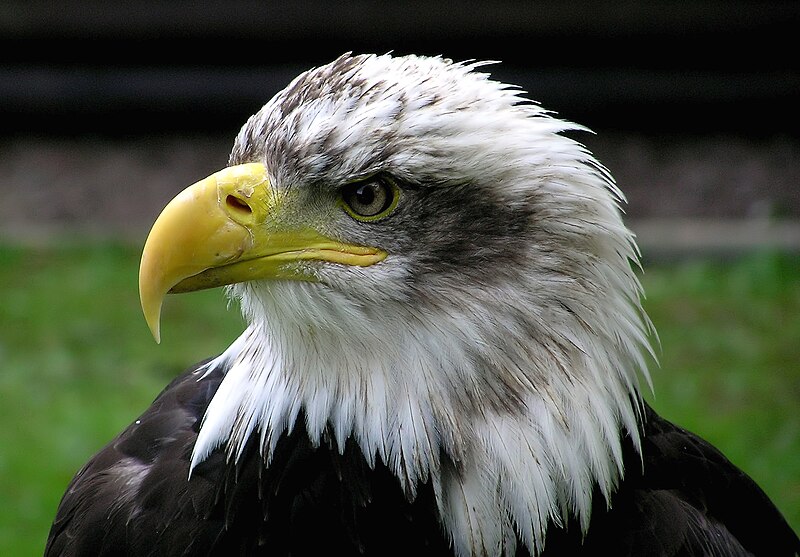
Taken by Adrian Pingstone in July 2004.

Did you know that Missouri is a top stop for many migrating bald eagles during the winter? Well, Missouri is actually a very popular "vacation spot" for our fine feathered friends, who are drawn to our state's large rivers, lakes and wetlands. In fact, all of our natural beauty, small game and habitat make Missouri one of the best spots in the lower 48 for avid bird watchers to spot a bald eagle.

In celebration of our winter visitors, and to bring attention to Missouri's year round bald eagle population, the Missouri Department of Conservation hosts Eagle Days throughout the state during the months of December, January and February, garnering you an excellent opportunity to learn more about our large flying friends through live captive-eagle programs, exhibits, activities, videos and MDC guides with spotting scopes. You'll be able to scan the water's edge and large trees for the more than 2,000 reported bald eagles, who may measure over six foot from wingtip to wingtip!

If you're looking to take advantage of the MDC Eagle Days, you'll want to hit up these locations during these dates (click to visit the area via Google Maps):
  • December 6 from 9 a.m. to 4 p.m. and December 7 from 10 a.m. to 4 p.m. at Squaw Creek National Wildlife Refuge. Contact number (816) 271-3100
  • January 10 from 9 a.m. to 3:30 p.m. and January 11 from 10:30 a.m. to 3:30 p.m. at Smithville Lake Paradise Pointe Golf Course Clubhouse. Contact number (816) 532-0174
  • January 17 from 9 a.m. to 4 p.m. and January 18 from 12:30 p.m. to 4:30 p.m. at the MDC Springfield Conservation Nature Center. Contact number (417) 888-4237
  • January 17 from 9 a.m. to 3 p.m. and January 18 from 9 a.m. to 3 p.m. at the Old Chain of Rocks Bridge. Contact number (314) 877-1309
  • January 24 from 9 a.m. to 4 p.m. and January 25 from 10 a.m. to 3 p.m. at Lock and Dam 24 an Apple Shed Theater in Clarksville. Contact number (660) 785-2420
  • February 7 from 9 a.m. to 4 p.m. at Mingo National Wildlife Refuge near Puxico. Contact number (573) 222-3589
    • Mingo National Wildlife Refuge is a personal favorite of our family! A great place to see a ton of nature...
If you'd rather avoid the guided tours and just take a weekend or weekday to try your luck at spotting a bald eagle, you may want to visit these sites (click to visit the area via Google Maps):
As always, enjoy and thank you for reading. I hope to see you out taking in an eyeful of eagle this winter. Please remember to bundle up though, Missouri gets C-O-L-D during these prime eagle viewing months.

Of course, if you want to get AMPED about the bald eagles, you may want to listen to a bit of this: Tick tock, tick, doo, doo, doo, doo... I wanna fly like an eagle, to the sea, fly like an eagle, let my spirit carry me...Hey, it sounds great when I sing it in my shower...

More Information:

Local Treks on facebook 
MDC Eagle Days Webpage
Additional Information On The Bald Eagle Photo At Top